
Comparing Swiss and Japanese Watchmaking Traditions
Choosing between a Swiss timepiece and a Japanese one is one of the most common dilemmas for new collectors. Both countries have built formidable reputations, but they've taken very different paths to get there. This guide breaks down the real differences in craftsmanship, pricing and long-term value so you can buy with confidence.
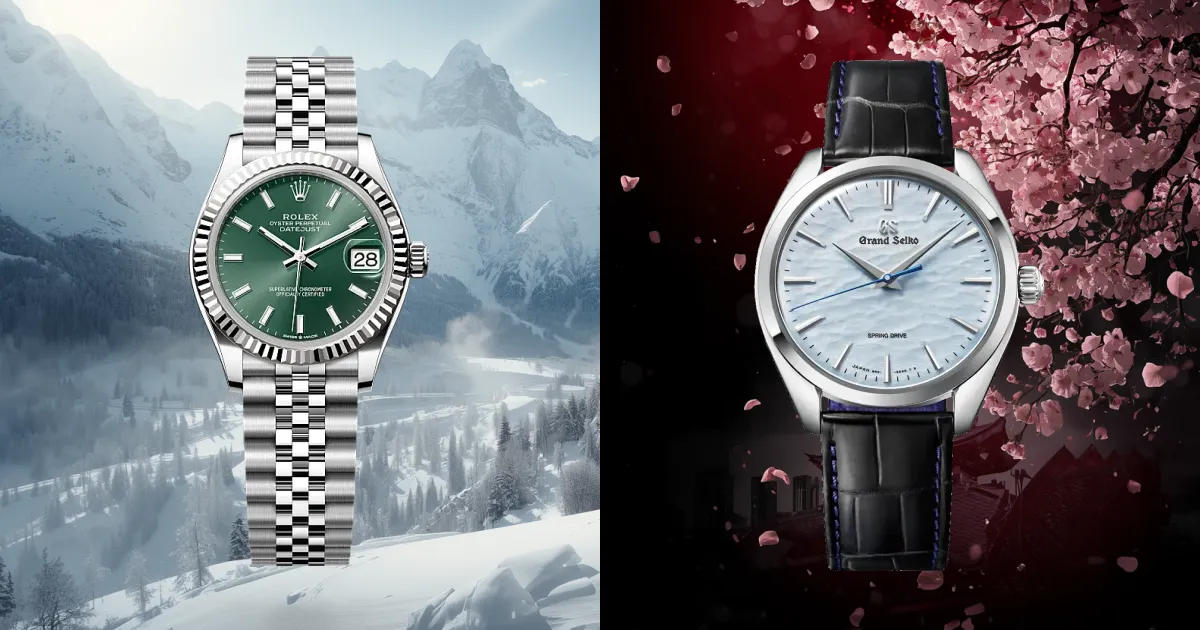
The Case for Swiss Craftsmanship
Swiss Watches
Switzerland's reputation rests on centuries of specialised craft. Watchmaking took root in the Jura mountains in the 16th century, and towns like Geneva and La Chaux-de-Fonds became hubs for skilled artisans working on complications, finishing and case-making.
That heritage still shapes how the industry operates today. Many Swiss houses maintain in-house movement production, hand finishing and small-batch assembly, which keeps output limited and prices high relative to mass production.
The Swiss Made label itself is tightly regulated. To carry it, a watch's movement must be assembled and cased in Switzerland, with a defined proportion of components sourced locally, a rule that protects the credibility of the industry as a whole.
This is part of why Swiss pieces dominate the secondary market for serious collectors. Brands with strong provenance, limited production and mechanical complexity tend to hold or grow in value over time, particularly steel sports models from the most sought-after maisons.
Servicing is another factor worth understanding before buying. Mechanical Swiss movements generally need attention every five to seven years, and while this adds ongoing cost, it also means a well-maintained piece can be passed down for generations.
For Australian buyers, this heritage carries real weight. Sydney and Melbourne both host authorised boutiques for the major Swiss houses, giving local buyers access to genuine servicing and warranty support without needing to go overseas.
None of this means Swiss watches are automatically the better investment. It simply means the value proposition is built on craft, scarcity and a long paper trail of provenance, which suits buyers who prioritise heritage over pure practicality.
Why Japanese Watchmaking Punches Above Its Weight
Japanese Watches
Japan's approach to watchmaking developed along a different path, one shaped heavily by engineering discipline rather than centuries-old guild tradition. Seiko's introduction of the world's first quartz watch in the 1960s reshaped the entire industry and forced Swiss makers to rethink how they competed.
That quartz revolution still defines much of Japan's identity in the space. Precision, reliability and value for money remain the core selling points, and Japanese movements are renowned for keeping exceptional time at a fraction of the cost of comparable mechanical alternatives.
Where things get interesting for collectors is at the top end. Grand Seiko has spent decades building genuinely high horology credentials, with in-house movements, hand-applied dials and finishing that rivals brands charging several times more.
Quartz and Spring Drive movements offer accuracy that many mechanical Swiss calibres can't match
Entry-level Japanese pieces provide a genuine mechanical watch experience at accessible price points
High-end Japanese houses are increasingly recognised at international watch fairs and auctions
Resale performance for Japanese watches has traditionally lagged behind the top Swiss names, though this gap has been narrowing as global appreciation for Japanese craftsmanship grows. Grand Seiko in particular has developed a loyal following among collectors seeking an alternative to the more hyped Swiss sports watches.
Australian buyers benefit from strong local distribution networks for the major Japanese brands, along with more accessible servicing costs. For anyone building a first serious collection, a Japanese piece often makes a sensible, lower-risk entry point.
Swiss vs Japanese Watches: The Australian Buyer's Perspective
Australian collectors are in a fortunate position, with genuine access to both traditions through authorised dealers, boutiques and a healthy grey market. Working out whether to buy Swiss or Japanese ultimately comes down to what you value most as a buyer.
Price is usually the first consideration. Japanese brands generally offer stronger value at entry and mid-tier price points, while Swiss brands dominate the luxury end where heritage and complexity command a premium.
Servicing costs and turnaround also matter more than most first-time buyers expect. Authorised Swiss servicing in Australia can involve longer wait times given demand, while Japanese brands often have quicker local turnaround and lower running costs.
When weighing up a purchase, it helps to think through the practical factors before comparing specific models:
Set a realistic budget that includes servicing, not just the purchase price
Decide whether mechanical heritage or quartz precision matters more to you
Research resale performance for the specific model, not just the brand
Check local availability of authorised servicing before committing
Consider whether you're buying to wear daily or to hold as part of a collection
The good news is that neither choice is a wrong one. A well-chosen Japanese piece can offer years of reliable daily wear at a sensible price, while a well-chosen Swiss piece can become a genuine long-term asset. Understanding this watch brands comparison is the first step to buying with intention rather than hype.

Explore Watch Comparisons
Swiss vs Japanese Watches FAQs
The main difference lies in philosophy and heritage. Swiss watchmaking is built around centuries of mechanical tradition, in-house movement production and strict labelling standards, which supports higher prices and strong collector demand.
Japanese watchmaking developed around precision engineering and quartz innovation, offering reliable timekeeping at more accessible prices. Both countries now produce excellent mechanical watches, but Switzerland still leads in high complications and prestige, while Japan leads in value and everyday reliability.
Neither tradition is objectively better. The right choice depends on whether you prioritise heritage and resale potential or accuracy and practicality.
In terms of build quality and accuracy, Japanese watches are genuinely excellent, and in some cases more precise than Swiss mechanical equivalents. Brands like Grand Seiko have proven that Japanese finishing and in-house engineering can compete with respected Swiss houses.
Where Swiss watches still tend to lead is in complications, hand finishing traditions and overall market prestige, which flows through to resale value at the top end.
For everyday wear and reliability, Japanese watches hold their own comfortably. For deep collector status and long-term brand cachet, Swiss watches currently have the edge.
Generally, yes, particularly among well-known Swiss brands with strong provenance and limited production. Steel sports watches from the most established Swiss houses have shown consistent demand on the secondary market.
Japanese watches have historically depreciated faster, though this is changing as collectors increasingly recognise the quality of high-end Japanese pieces. Grand Seiko models, for example, have started to show improved retention compared to standard production Japanese watches.
Resale value always depends on the specific model rather than the country of origin alone, so research individual pieces before assuming a blanket rule applies.
Swiss watches carry higher production costs due to hand finishing, in-house movement manufacturing and smaller batch sizes. Strict Swiss Made regulations also require a significant proportion of components to be sourced and assembled locally, which adds cost compared to more automated production methods.
Brand heritage and marketing also play a role, with decades of prestige built into pricing. Japanese manufacturers, by contrast, have historically prioritised efficient, large-scale production, which keeps prices lower without necessarily compromising quality.
The price gap reflects different business models as much as it reflects any real difference in reliability or accuracy.
For a first purchase, a Japanese watch is often the more sensible starting point. You get genuine mechanical or high-accuracy quartz engineering at a lower price, with lower servicing costs while you're still learning what you like in a watch.
A Swiss piece makes sense as a first purchase if you already have a clear budget and a strong preference for a specific brand or complication. Just be prepared for higher upfront and ongoing servicing costs.
There's no wrong starting point, but starting with a Japanese watch lowers financial risk while you build your knowledge of the wider market.