
Rolex vs Tudor: A Complete Guide to Choosing Between Two Iconic Watch Brands
Rolex and Tudor are two of the most recognised watch brands in the world, and while they share a common heritage, they occupy very different spaces in the market. Whether you're buying your first serious timepiece or adding to a growing collection, understanding what sets these two brands apart is essential. This guide breaks down the key differences across design, movement quality, price, and long-term value so you can make a confident decision.
Brand Heritage and the Rolex-Tudor Connection
Few people realise how closely linked Rolex and Tudor actually are. Hans Wilsdorf, the founder of Rolex, created Tudor in 1926 as a more accessible sibling brand, allowing him to offer quality Swiss watches at a lower price point without diluting the prestige of the Rolex name.
For decades, Tudor watches used many Rolex-supplied components, including cases and certain movement parts. This gave Tudor a credibility that other affordable Swiss brands simply couldn't match. The relationship has evolved over time, but the shared DNA remains a key part of what makes Tudor so compelling for buyers who want genuine Swiss quality without the flagship price tag.
Design Language and Identity
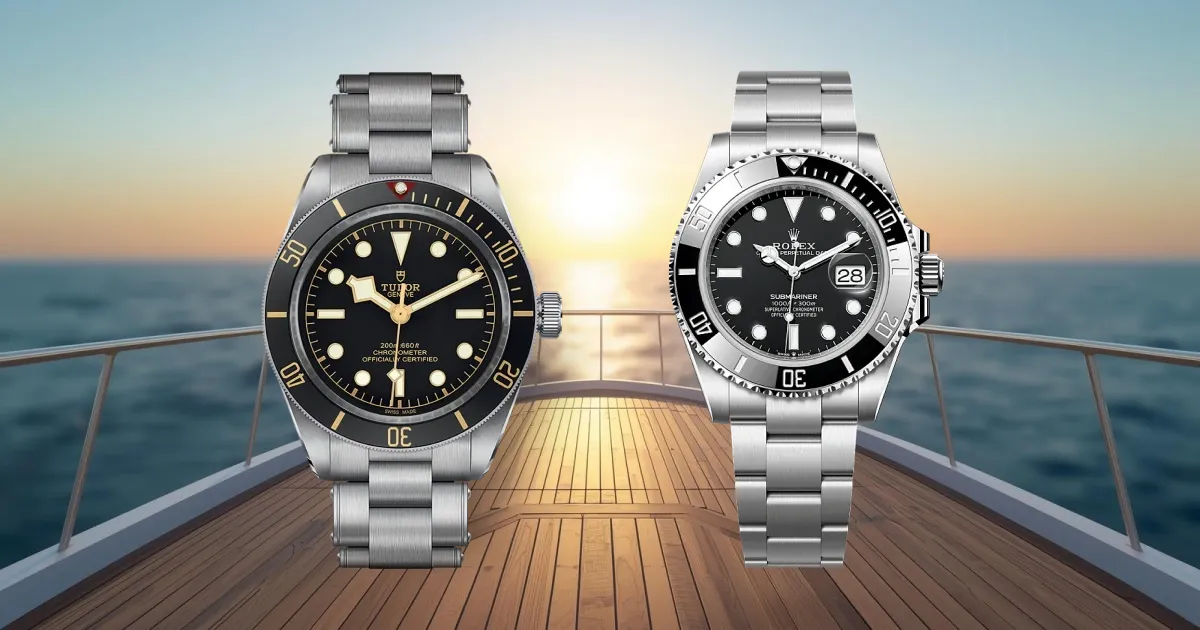
Rolex has spent nearly a century building one of the most consistent and recognisable design languages in watchmaking. The Submariner, Datejust, and Daytona are icons that need no introduction. Every detail, from the Oyster case to the Jubilee bracelet, is refined to near perfection.
Tudor, on the other hand, has done something interesting in recent years. Rather than simply imitating Rolex aesthetics, the brand has carved out its own visual identity. The Black Bay collection draws on classic dive watch heritage while adding bold colour choices and distinctive design details like the "snowflake" hands that have become a Tudor trademark.
For Australian collectors, Tudor has developed a strong following thanks to its ability to deliver that same robust, sports-watch aesthetic at a more accessible entry point. Both brands are widely available through authorised dealers in Sydney, Melbourne, and Brisbane, making comparisons easy to make in person.
Movement Quality, Specifications, and Value for Money
When comparing movements, Rolex operates at the very top of the industry. The brand manufactures its own movements entirely in-house, with proprietary alloys, ceramic components, and finishing standards that are benchmarks for the entire Swiss watch industry. Rolex movements are COSC-certified as a baseline and then tested to even tighter tolerances before leaving the factory.
Tudor spent many years using ETA and Sellita movements sourced from third-party suppliers, which was one of the most common criticisms levelled at the brand. That changed significantly when Tudor introduced its own in-house calibres, starting with the MT5621 in 2015. These movements are now COSC-certified, include a 70-hour power reserve, and feature a silicon balance spring, putting Tudor firmly in the upper tier of what you'd expect at its price point.
Price and What You Get for Your Money
The price gap between the two brands is substantial and important to understand. Entry-level Tudor sports watches typically retail for between AUD $4,000 and $6,000, while comparable Rolex models start closer to AUD $10,000 and can stretch well beyond that for steel sports references on the secondary market.
That difference in price does not translate directly to a difference in quality, at least not at the level most wearers would notice day to day. Tudor watches are robust, accurate, and beautifully finished. What you are paying for with Rolex, to a significant degree, is brand prestige, history, and the unmatched resale performance that comes with it.
For buyers working within a budget, Tudor delivers exceptional watchmaking for the spend. For those focused on long-term value retention, the Rolex vs Tudor debate often tips in favour of Rolex simply because of how the secondary market performs.
Buying Rolex or Tudor in Australia: What You Need to Know
The Australian watch market has its own dynamics that are worth understanding before you buy. Rolex has maintained authorised dealer relationships with a select group of retailers across Australia, and demand for steel sports models continues to outpace supply. Waitlists at authorised dealers are common, particularly for the Submariner, GMT-Master II, and Daytona references.
Tudor sits in a far more accessible position. Stock availability is generally better, pricing is transparent, and you won't be asked to build a purchase history before being offered the watch you want. For buyers who find the Rolex experience frustrating, Tudor offers a refreshingly straightforward path to ownership. Consulting a solid Rolex guide before visiting dealers can also help you navigate the authorised dealer landscape with realistic expectations.
Key Considerations for Australian Buyers
When deciding between the two brands in the Australian market, keep the following in mind:
Resale value: Rolex holds value exceptionally well on the Australian secondary market, with popular steel sports models often selling above retail. Tudor resale is solid but not comparable to Rolex at this stage.
Availability: Tudor watches are generally in stock at authorised dealers. Rolex sports models require patience and often a relationship with a retailer.
Entry price: Tudor offers a genuine Swiss sports watch experience from around AUD $4,000. Rolex entry points are typically two to three times higher.
Movement quality: Both brands now offer in-house, COSC-certified movements. The gap in movement specification has narrowed considerably.
Lifestyle fit: If a watch is primarily for wearing and enjoying, Tudor represents outstanding value. If long-term investment potential matters, Rolex is the stronger case.
Exploring the full range of Tudor watches available locally is worth doing before making a final decision, as the breadth of the collection often surprises first-time buyers.



Watch Comparison Hub
Rolex vs Tudor FAQs
Tudor is not owned by Rolex, but the two brands share a parent company. Hans Wilsdorf founded Tudor in 1926 as a sister brand to Rolex, with the goal of offering quality Swiss watches at a more accessible price. Today, both brands fall under the Wilsdorf family-controlled holding structure, but they operate independently with separate identities, collections, and distribution networks. Tudor has its own in-house movements and a distinct design direction that sets it apart from its more famous sibling.
Tudor and Rolex movements are both high quality, but Rolex operates at a higher level of refinement. Rolex manufactures everything in-house using proprietary alloys and holds its movements to tighter tolerances than COSC certification requires. Tudor introduced its own in-house movements from 2015 onwards, and these are COSC-certified with impressive specifications including a 70-hour power reserve and silicon balance spring. For everyday wear, most owners would not notice a meaningful difference in performance. For collectors focused on finishing and horological prestige, Rolex is the clear leader.
Rolex is widely regarded as one of the strongest value-retaining watch brands in the world, and Tudor does not match that level of secondary market performance. Popular Rolex steel sports models regularly sell above retail price on the pre-owned market. Tudor watches hold their value reasonably well compared to many other brands at a similar price point, but depreciation is more typical. If investment potential and resale value are primary concerns, Rolex is the stronger choice. If you are buying to wear and enjoy, Tudor offers excellent quality at a price where depreciation is less impactful.
Both brands make excellent first luxury watches, and the right choice depends on your priorities. Tudor is the more accessible starting point, with strong build quality, in-house movements, and a compelling design range at a lower price. It allows you to enter the world of Swiss sports watches without the waitlists or price premiums associated with Rolex. Rolex, however, offers a stronger long-term investment case and carries significantly more brand recognition. If budget is a key consideration, Tudor is a smart and satisfying first purchase. If you can stretch to Rolex, the long-term value proposition is hard to ignore.
In some cases, yes. Certain authorised dealers in Australia carry both Rolex and Tudor, though this varies by retailer and location. However, the buying experience can differ considerably. Rolex authorised dealers often manage waitlists and may require a purchase history before allocating high-demand models. Tudor is generally available off the shelf at authorised retailers, with straightforward pricing and no waitlist requirements for most references. It is worth contacting dealers directly or visiting in person to understand current stock and availability for both brands before making a decision.