
Rolex vs Omega: Which Swiss Watch Brand Is Right for You?
The Rolex vs Omega debate is one of the oldest and most genuinely interesting conversations in the watch world, and it refuses to be settled simply. Both brands are Swiss manufacture powerhouses with century-spanning histories, iconic reference families, and devoted collector communities. Where they diverge is in philosophy, pricing, movement technology, and the experience of ownership over time. This guide compares them honestly across every dimension that matters to a buyer making a serious decision.

Heritage, Brand Philosophy, and Iconic Collections
Rolex and Omega are among the two most recognised watch brands in the world, but they arrived at that status through very different journeys and with distinctly different identities. Understanding where each brand came from, and what that heritage means for the watches it produces today, is the most useful starting point for any serious comparison.
Rolex: Built on Proof and Prestige
Rolex was founded by Hans Wilsdorf in London in 1905 and relocated to Geneva after the First World War. From its earliest years the brand's strategy was to prove its watches against the most demanding real-world challenges rather than relying on heritage or tradition alone. The Oyster case, which introduced water and dust resistance to the wristwatch in 1926, was demonstrated by having swimmer Mercedes Gleitze wear one across the English Channel. The self-winding Perpetual rotor followed in 1931. The Datejust, the first automatic watch with a date window, arrived in 1945.
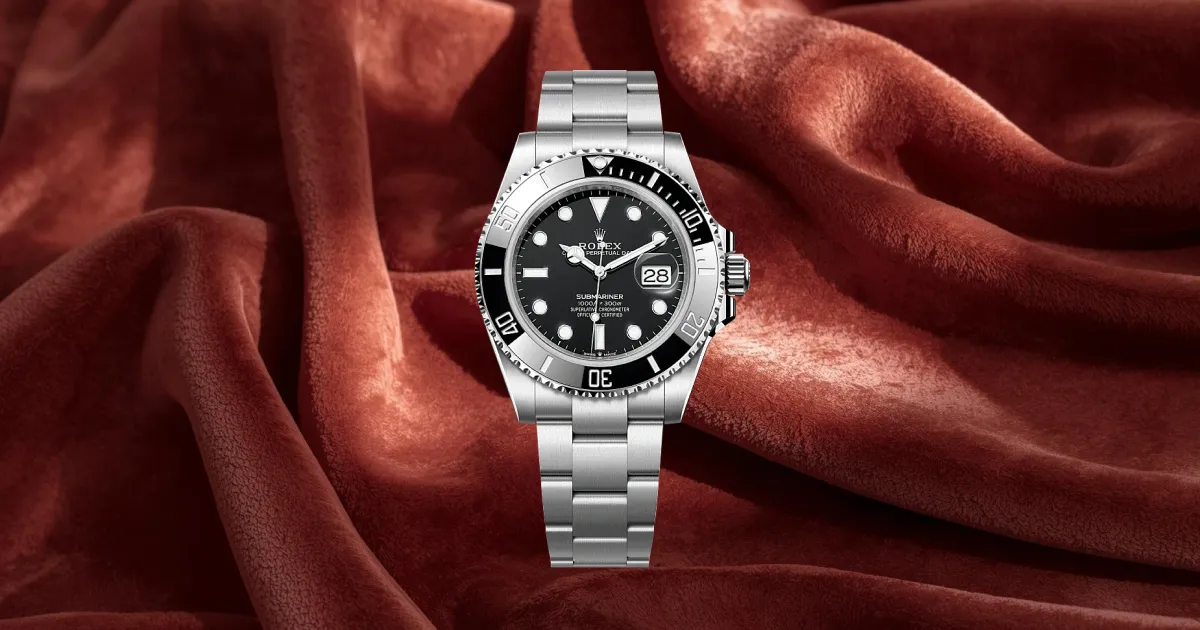
This pattern of innovation through demonstration continued across the decades. The Explorer was worn by Sir Edmund Hillary and Tenzing Norgay on the first ascent of Everest in 1953. The Submariner set the standard for professional dive watches in the same year. The GMT-Master was developed in collaboration with Pan American World Airways for transatlantic pilots in 1955. Each major reference was built around a specific, provable purpose, and that heritage of functional credibility is one of the most durable assets Rolex carries into the contemporary market.
Rolex is also unique among major luxury brands in its ownership structure. The brand is owned by the Hans Wilsdorf Foundation, a charitable trust established by its founder, which means it operates without the short-term shareholder pressure that drives production volume and margin decisions at publicly listed competitors. That structural independence is one reason Rolex has been able to maintain the production discipline that drives secondary market scarcity. For a comprehensive overview of Rolex's full reference history and current model range, a dedicated Rolex guide covers every major collection in depth.
Omega: Innovation, Space, and Sport
Omega was founded in La Chaux-de-Fonds in 1848 by Louis Brandt, making it 57 years older than Rolex and one of the oldest continuously operating watch manufacturers in Switzerland. The Omega name was adopted in 1894 to designate the brand's first mass-produced calibre with interchangeable components, and the brand quickly established itself as a leader in precision timekeeping. Omega has been the official timekeeper of the Olympic Games since 1932, a relationship that has continued unbroken across more than two dozen Games and represents one of the longest-running sports sponsorships in history.
The Speedmaster's association with NASA and the Apollo programme is Omega's most storied achievement. Following rigorous testing by NASA in 1965 that evaluated eleven watches against eleven criteria including temperature extremes, humidity, vacuum, and shock resistance, the Speedmaster was the only watch to pass all tests. It became the official watch of human spaceflight and was worn by astronaut Buzz Aldrin on the surface of the Moon during the Apollo 11 mission in 1969. That heritage is irreplaceable and gives the Speedmaster a place in history that no marketing budget can manufacture after the fact.
Omega has also pursued genuine technical leadership in movement development. The Co-Axial escapement, developed by independent watchmaker George Daniels and licensed to Omega in 1999, reduces friction between the movement's escapement components, extending service intervals and improving long-term accuracy. The METAS Master Chronometer certification, introduced in collaboration with Switzerland's Federal Institute of Metrology, certifies Omega movements to an accuracy of 0 to plus 5 seconds per day under real-world conditions including exposure to magnetic fields of up to 15,000 gauss. That magnetic resistance standard exceeds the COSC chronometer specification and represents a genuine technical advantage over most competing movements.
Movement Technology, Accuracy, and Price Comparison
Both Rolex and Omega are full manufacture brands, meaning they design, develop, and produce their own movements in-house. That shared characteristic puts them above a significant portion of the Swiss watch industry, but within that shared credential the two brands take meaningfully different approaches to movement development, certification, and the technical claims they make for their calibres.
Movement Technology
Rolex movements are certified as Superlative Chronometers, a designation that requires two stages of independent testing: certification by COSC to within minus 4 and plus 6 seconds per day, followed by in-house testing by Rolex to its own more demanding standard of plus or minus 2 seconds per day once the movement is cased. Rolex also uses 904L stainless steel for its cases and bracelets, a grade of corrosion-resistant steel originally developed for the aerospace and chemical industries that is harder to machine and more expensive to source than the 316L steel used by most competing brands. Every element of a Rolex is manufactured and assembled in Switzerland across the brand's own facilities in Geneva, Biel, and Plan-les-Ouates.
Omega's Co-Axial escapement and METAS Master Chronometer certification represent a different approach, one that emphasises measurable technical advancement over the incremental refinement that characterises Rolex's engineering philosophy. The silicon balance spring used in Omega's Master Chronometer calibres is impervious to magnetic fields, immune to temperature variation, and does not require lubrication, which extends theoretical service intervals beyond those of conventional lever escapement movements. In purely technical terms, Omega's METAS certification is more stringent than COSC chronometer specification, and the brand's anti-magnetic performance in daily wear conditions is a genuine, independently verified advantage.
Price Comparison
The price gap between the two brands is significant and consequential for buyers at every level. Entry-level Omega references such as the Seamaster Diver 300M and the Speedmaster Professional Moonwatch retail in a range broadly accessible to first-time Swiss luxury buyers in Australia. Entry-level Rolex references such as the Oyster Perpetual and Explorer sit at a higher price point, and the most sought-after Rolex sports models, including the Submariner, GMT-Master II, and Daytona, either carry retail prices that reflect their specification and prestige, or are simply not available at retail due to allocation constraints that push buyers to the secondary market at a premium. For a full breakdown of Omega's current model pricing and collection structure across its major reference families, a comprehensive Omega guide provides the detail needed to compare specific references accurately.
The implication of this price differential is that Omega delivers more watch for the money in purely technical and specification terms across most comparable reference types. The Seamaster Diver 300M offers METAS Master Chronometer movement quality, a ceramic bezel, and 300-metre water resistance at a retail price meaningfully below the comparable Rolex Submariner. The Speedmaster Professional offers one of the most historically significant movements in watchmaking, a manual-wind calibre with a documented moon landing heritage, at an accessible price that positions it as one of the strongest value propositions in the Swiss luxury category.
Resale Value and Secondary Market Performance
This is where the comparison tips decisively in Rolex's favour. Rolex sports models including the Submariner, Daytona, and GMT-Master II consistently trade at or above their retail prices on the secondary market, a phenomenon driven by genuine supply constraints and sustained global collector demand that shows no sign of diminishing. The Rolex brand's secondary market dominance is not a temporary market distortion. It reflects decades of consistent production discipline, global brand management, and the accumulation of cultural prestige that makes certain Rolex references genuinely scarce assets rather than simply expensive consumer goods.
Omega watches, by contrast, typically depreciate off their retail price once purchased new, with the exception of certain limited editions, vintage references, and historically significant models. The Speedmaster Professional holds its value better than most Omega references due to its cultural heritage, and certain vintage Seamaster and Speedmaster examples have appreciated meaningfully over time. But for buyers who view secondary market performance as a primary criterion, Rolex is the clearer and more consistently documented choice.
Rolex vs Omega in Australia: Which Brand Is Right for You?
Both brands have strong and well-established presences in the Australian market. Rolex operates a controlled authorised dealer network through boutiques and selected multi-brand retailers in Sydney, Melbourne, Brisbane, and Perth, with allocation management that means access to the most sought-after sport references can require establishing a purchase history with a preferred dealer. Omega has a broader retail footprint, with dedicated boutiques and a wider authorised dealer network that makes its references generally accessible at retail without the waitlist dynamics that apply to several Rolex models.
Australian buyers should also consider the ownership experience over time. Both brands offer five-year international warranties from their authorised networks, and both maintain authorised service centres in Australia for movement servicing, case restoration, and bracelet work. The cost of a full service differs between the brands, with Rolex service pricing generally higher than Omega across equivalent reference types. Over a five to ten year ownership period, servicing costs are a real component of the total cost of ownership that buyers sometimes underweight when comparing purchase prices.
The current secondary market in Australia reflects global patterns, with Rolex sports references trading above retail through specialist pre-owned dealers and on platforms like Chrono24, while Omega references are broadly available at or below retail in the pre-owned segment. For buyers who are willing to navigate the pre-owned market, Omega offers some of the best value in Swiss luxury watchmaking at its current secondary pricing, while Rolex's secondary market premiums reflect the scarcity that also makes its strongest references the most defensible long-term holdings.
Here is a step-by-step decision framework to help you choose between the two brands:
Define your primary motivation: If investment value and secondary market performance are your priority, Rolex is the more defensible choice. If you value technical innovation, movement credentials, and maximum watch for your budget, Omega delivers more at comparable price points.
Assess your budget realistically: Omega's entry-level sport references offer genuine Swiss manufacture quality at a lower price than comparable Rolex sport models. If your budget is between AUD 7,000 and AUD 12,000, Omega gives you more specification and immediate availability. Above AUD 12,000, Rolex sport references become accessible and carry stronger resale credentials.
Consider access and availability: Several Rolex sport references require building a purchase relationship with an authorised dealer before allocation becomes available. Omega references are broadly available at retail without equivalent constraints, which matters if you want to make a purchase decision on your own timeline.
Think about the ownership experience you want: Rolex ownership carries stronger cultural recognition, a more universal prestige signal, and greater long-term liquidity. Omega ownership offers deeper technical engagement, a more varied and frequently updated reference catalogue, and access to a brand whose manufacture heritage includes some of the most extraordinary moments in watchmaking history.
Evaluate the specific reference, not just the brand: The comparison between a Rolex Submariner and an Omega Seamaster Diver 300M is different from the comparison between a Rolex Daytona and an Omega Speedmaster. Assess the specific reference you are considering on its own merits against the closest comparable, rather than treating either brand as monolithically better or worse.



Explore Secondary Market Winners
Rolex vs Omega FAQs
Neither brand is objectively better because they are optimised for different things. Rolex delivers stronger secondary market performance, greater resale liquidity, and more universally recognised prestige. Omega delivers more technical innovation, more accessible pricing across most comparable references, and movement credentials including METAS Master Chronometer certification that are arguably more advanced than Rolex's Superlative Chronometer standard. The better brand depends entirely on what you are trying to achieve. For investment performance and cultural prestige, Rolex leads. For technical value and accessible luxury, Omega is the stronger proposition at most price points.
Generally, no. Rolex sports models including the Submariner, Daytona, and GMT-Master II consistently hold or exceed their retail prices on the secondary market, driven by genuine production scarcity and sustained global demand. Most Omega references depreciate off their retail price when purchased new, stabilising over time rather than appreciating. Exceptions include the Speedmaster Professional, which holds its value better than most Omega references due to its moon landing heritage, and certain vintage Omega models and limited editions. For buyers who prioritise secondary market performance, Rolex is the consistently stronger performer across its core sport reference families.
Omega's METAS Master Chronometer certification is technically more stringent than Rolex's COSC-based Superlative Chronometer standard. METAS certification requires accuracy of 0 to plus 5 seconds per day under real-world conditions including exposure to magnetic fields of up to 15,000 gauss, tested independently by Switzerland's Federal Institute of Metrology. Rolex's in-house Superlative Chronometer standard targets plus or minus 2 seconds per day once the movement is cased. In practical everyday terms, both brands produce movements of extraordinary accuracy, and the difference is rarely perceptible in daily wear. Omega's anti-magnetic performance in particular gives it a measurable technical advantage in environments with high electromagnetic fields.
Omega is considerably easier to purchase at retail in Australia. Omega boutiques and authorised dealers carry stock of the brand's most popular references including the Seamaster and Speedmaster, and buyers can generally make a purchase decision and complete a transaction on their own timeline without waitlisting. Rolex's most sought-after sport references including the Submariner, Daytona, and GMT-Master II are subject to allocation management by authorised dealers, meaning access often requires an established purchase history with a preferred dealer. Buyers who want a specific Rolex sport reference immediately typically need to navigate the pre-owned market and pay a premium above retail.
The most direct Omega alternative to the Rolex Submariner is the Omega Seamaster Diver 300M, which offers comparable 300-metre water resistance, a ceramic bezel, and METAS Master Chronometer movement credentials at a meaningfully lower retail price. For buyers drawn to the Rolex Daytona as a sports chronograph, the Omega Speedmaster Professional offers a genuine technical and heritage story that in some respects is even more compelling, at a substantially more accessible price. For buyers interested in a versatile daily wear reference comparable to the Rolex Datejust, the Omega Aqua Terra and Seamaster Aqua Terra families offer elegant, METAS-certified automatic watches with strong authorised dealer support across Australia.